

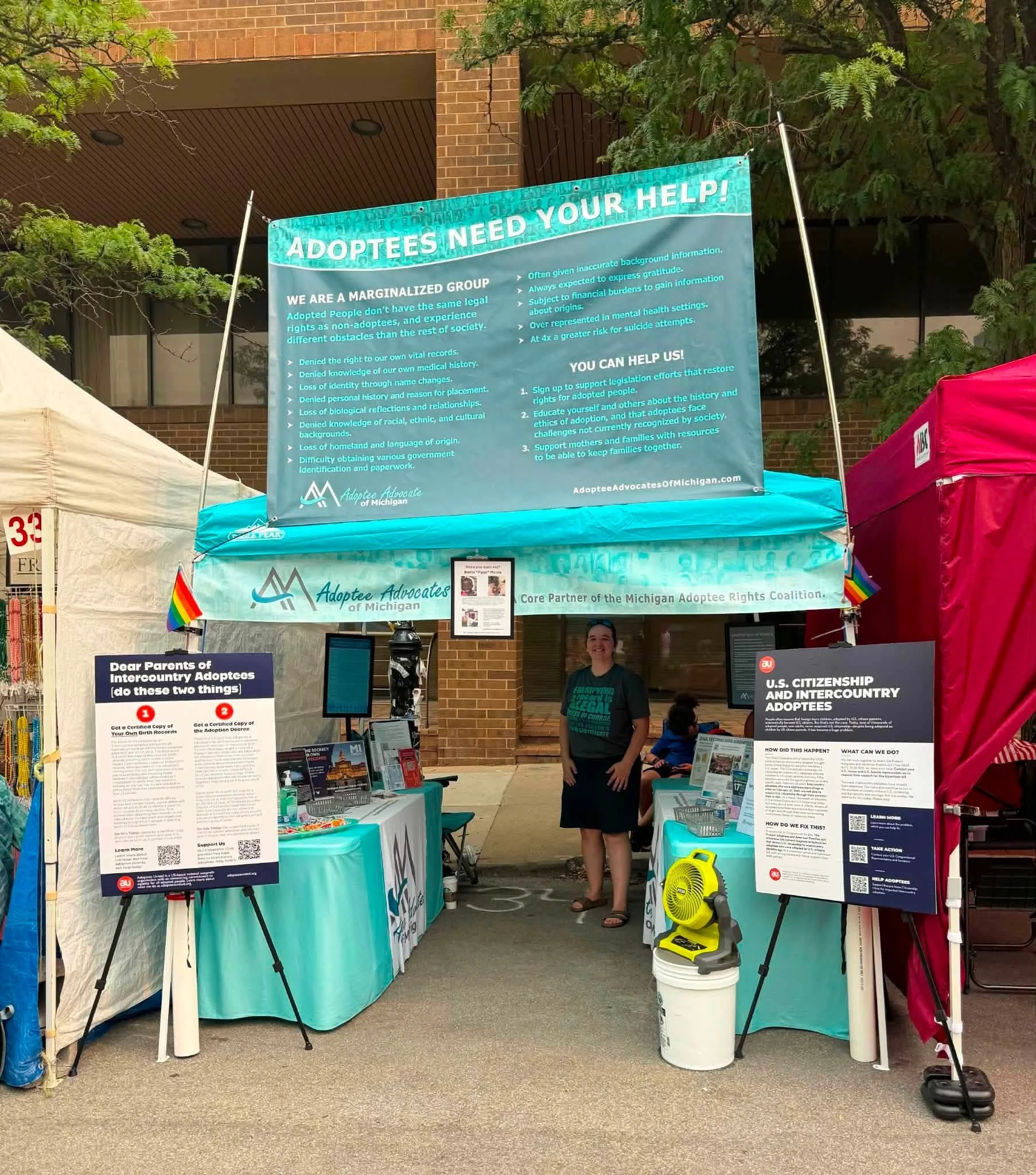
AAOM Booth Set Up at the Ann Arbor Art Fair, July 2026
This summer, Adoptee Advocates of Michigan continued our grassroots outreach with advocacy booths at the Trenton Summer Festival and the Ann Arbor Art Fair. Throughout the summer, we distributed educational materials from a number of adoptee-led and birth parent organizations, helping connect people with information, resources, and support.
We often begin conversations with a simple statement:
"We don't have the same rights as you."
For many people, that sentence comes as a surprise. Most have no idea that adopted people remain one of the last marginalized groups in the United States to be denied equal rights based solely on their adopted status. Those conversations opened the door to discussing the many legal inequalities adoptees continue to face.
One of our primary goals this summer was raising awareness about the citizenship crisis affecting intercountry adoptees. Many people are shocked to learn that some legally adopted people were never granted U.S. citizenship and continue to face the risk of detention or deportation. We distributed postcards and informational flyers from Adoptees United and Adoptees for Justice to educate the public about this ongoing crisis and provide resources for adoptees who may need legal assistance. We are asking the public, especially those with a connection to adoption, to help by contacting their federal congress person and ask them to support the Protect Adoptees and American Families Act. (The PAAF ACT)
Access to original birth certificates remained another major topic of discussion. Today, 17 states recognize that adopted adults should have the same right as everyone else to obtain their own original birth certificate. Since Michigan's effort to restore that right stalled in the Senate committee chaired by Senator Stephanie Chang in 2024, three additional states, Minnesota (2024), Georgia (2025), and Virginia (2026), have enacted laws restoring equal rights for adopted adults. These states have recognized that adopted people are fully capable of responsibly handling information about their own identities and families and to treat them otherwise is discriminatory.
At both events, we met Michigan adoptees from every walk of life and across the political spectrum. Many shared their frustration that Michigan continues to deny them access to their own original birth records. We agree. Michigan should join the growing number of states that recognize adopted people deserve the same rights as everyone else.
Voting rights were also an important part of our outreach. A citizen initiative has gathered enough signatures to place a proposal before Michigan voters that could require documentary proof of citizenship when voting. Because Michigan continues to restrict access to original birth certificates, and because we have documented cases of Michigan-born adoptees struggling to obtain documents such as REAL IDs and passports, we are concerned about the consequences these types of requirements could have for adopted people. If even one eligible adoptee is prevented from voting because they cannot obtain the documents the state itself withholds, that is one too many. Helping the public understand these unique barriers has become an important part of our educational efforts.
We also shared information from the Society for Adoption Truth documenting children who have died in foster and adoptive homes. One case that continues to weigh heavily on us involves an adoptee who was originally from the Traverse City area. After being separated from a sibling through rehoming, the child was ultimately taken to Florida, where they died from starvation. The death was ruled a homicide in 2022, yet no one has been charged. Because of Michigan's adoption secrecy laws, it has been nearly impossible to identify the agency responsible for placing the child or fully understand how these failures occurred. Greater transparency and accountability are essential as we see tragedies like this happening frequently all around the nation. To learn more about this story, please visit Justice for Begidu.
Another issue we discussed with the public was the connection between adoption and child trafficking. While adoption can provide permanency for some children, it can also create opportunities for exploitation when systems prioritize the needs of adults over the rights and needs of children. We also raised concerns about efforts to expand Safe Haven Baby Boxes in Michigan. Our organization opposes these proposals because we believe they sever a child's identity and family connections without first exhausting options that preserve families whenever safely possible. Those interested in learning more can review Stop Safe Haven Baby Boxes Now’s talking points.
Throughout the summer, we also met birth mothers who were looking for support or simply someone who understood their experience. We were able to connect them with organizations and resources dedicated to supporting first families and others affected by adoption. You can find birth parent and constellation resources on our support page.
Despite the extreme heat, poor air quality caused by Canadian wildfire smoke, and long days outdoors, we continue to show up because these conversations matter. We spoke with hundreds of people, many of whom had no personal connection to adoption but immediately understood the fairness of one simple principle:
All people have the right to know where they come from, including adopted people.
Every conversation helps shift the public understanding of adoption away from the narratives promoted by a multi-billion-dollar adoption industry and toward the lived realities of adoptees and first families. We hope that sharing our experiences promotes the cause of family preservation, and the growing public support reminds us that this work matters and that meaningful change is possible.
None of this would be possible without our volunteers. We are deeply grateful to every adoptee and birth parent who gave their time to stand beside us, share their lived experiences, answer difficult questions, and help educate the public. Grassroots advocacy only succeeds because people are willing to show up, and we could not do this work without you. Thank you for helping us amplify the voices of adoptees and first families across Michigan.